Past Episodes:

My Friend Who Doesn't Make Plans
Last week I texted a friend inviting him to join me and some other friends for a walk. He responded saying “Maybe, TBD”. Unfortunately he didn’t end up making it out. Reflecting on my relationship with him over the last year or two, I don’t know that we’ve spent time together outside of spontaneously bumping into each other.
He’s the type of person that doesn't like planning things. Now it’s not like his way doesn’t work, he gets a lot done and is a functioning member of society. But what I’ve noticed is that our different ways of operating within the world are incompatible. I am pretty structured. I like making plans in advance and being proactive about allocating time for people and things that I want to do.
It’s clearly not a good recipe for our friendship, but what does it mean about our different approaches to life? What are the tradeoffs?
I can certainly speak for myself. Being organized and structured helps me to live more intentionally. I design my days so that they’re full of the things I want to do. As a result I live a balanced life, make progress on things I care about, invest in the people I want to spend time with, and keep space for the personal time that I need. The downside is, I’m less flexible and cannot accommodate new plans as well. I miss out on some great moments because I’m already committed to doing something else.
On the flip side, my friend who is less scheduled and more open can feel into what he wants to do in the moment. He probably can be more present with what he’s doing because he doesn't have in the back of his mind what he needs to get to next, or what he was supposed to be doing. He probably meets the moment a little bit better because he chooses it in real-time rather than planning it in advance. However, I imagine the downside is that he’s not as deliberate about investing in things like relationships, and struggles to build momentum toward longer term goals.
Neither is better or worse. They’re different operating systems. I design what I want out of life, he responds to what life presents. Both can make a person happy.
No matter the nature of the differences, It’s a bummer to me because I value his friendship and we don’t spend much quality time together. And I wonder if he notices that we aren’t as close as we could be. In any case, it’s interesting to observe how different people with different approaches to life attract different things into it.
...
See MoreEffective Strategic Planning
An area that I’ve been really focused on in my life and business is strategy. As I understand it, your strategy is the best approach you know to achieve a desired result. The better the approach, the more likely you’ll achieve what you want.
I’ve found the most effective way to incorporate strategy into my life is through strategic planning sessions. This involves on a weekly, monthly, quarterly, or annual basis reviewing how things are going and understanding what’s working and what’s not. When you step away from execution to observe your performance, you can gain insights that improve your efforts.
In attempting to maximize the impact of my strategy and strategic planning sessions, two main roadblocks have come up.
The first is related to actually completing the session itself. When you carve out time in your calendar for it, it often gets deprioritized because long-term strategic planning isn’t as urgent as short-term task completion. Especially when compared to the projects that you’re behind on, people you need to get back to, and the things that broke that you need to fix. So we naturally feel a pressure to compromise our commitment to complete a strategic planning session and fill the block with more time-sensitive things.
The second is on the opposite side of the spectrum where you reconsider your strategy too often. When you execute a strategy for a while and don’t see results yet, it can get discouraging. And given the flood of information and ideas we’re surrounded by these days, there’s no shortage of new things to try that might work. It’s a version of shiny-object syndrome where you jump from strategy to strategy in an effort to find what works. But when you’re not committed enough to a single strategy, nothing will work.
That’s why you need to find that sweet spot: You protect a strategic planning session so that you can determine the best strategy to meet your goals, and then you stay committed to that strategy and execute until it’s time to revisit it.
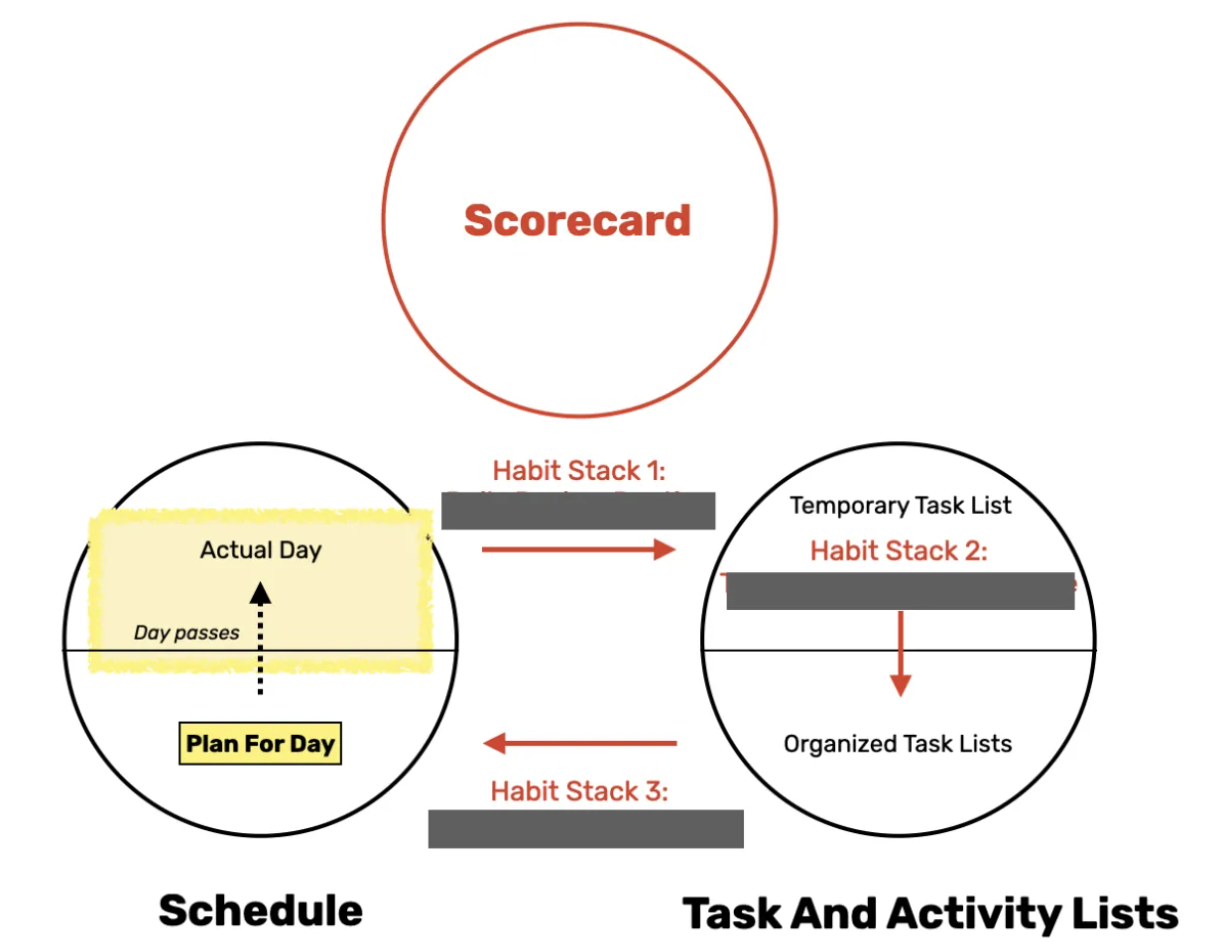
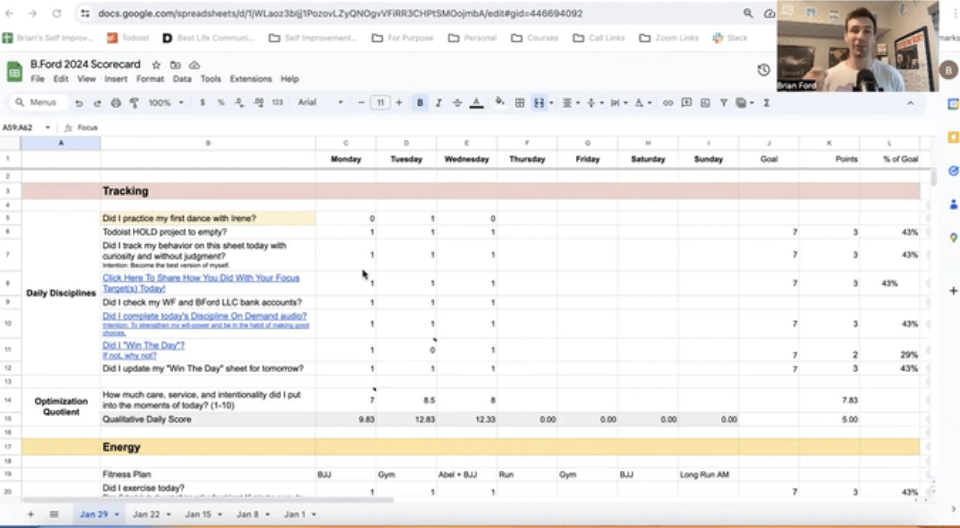
Underlying successful strategic planning are systems of measuring performance, organizing your tasks, organizing your schedule, and taking consistent action. If you want to see the systems I use on a daily basis to help me with all of those things, I’ve got videos overviewing all of them. Click here to check out some of my high performance systems.
...
See More3 Questions To Know If You're Successful
Something that people like us, who are ambitious and deeply invested in their self-growth, are chasing in their life is to be successful. And while society measures success in one way, we’ve learned that the secret to success is defining it for yourself.
Understanding the role that seeking success has played in my life, I’ve gone through a few iterations of it myself. I adopted Darren Hardy’s definition whereby you reflect on how you’re doing in 6 areas of your life to audit your holistic success. I love John Wooden’s definition for success, which is “Peace of mind, which is a direct result of self-satisfaction in knowing you made the effort to become the best of which you are capable".
For whatever reason, last week something came to mind that suggested success is even simpler. Knowing if you're successful comes down to your answer to 3 questions:
- Are you happy? It’s a hard question to answer, but such an important quality in life. To be happy means that you generally feel positive emotions of contentment and inner peace. While sensations of happiness are informed by experiences, it really is an internal relationship with how you view life around you.
- Are you and your loved ones provided for? This is primarily financial but by a different definition. It’s a matter of if your baseline needs are met or not. Most people associate making more money with being more successful, but what if financial success is a game of meeting a quantified minimum standard rather than filling an endless pit of more?
- Do you feel like you have a sense of purpose? That doesn’t necessarily mean that you’re making a big difference in the world, it can just be that you have a role to play in your world. To have a purpose means that you have a reason to wake up in the morning, and whether it’s helping people who depend on you, clients in business having a more positive experience, or something else, all you need is some engine that actively fuels your life.
Maybe we look at it from the other side. The opposite of being successful is being a failure. What ultimately means that someone is failing at life? Perhaps they’re not enjoying it, they’re not provided for, and they don’t have a sense of meaning.
For whatever reason, the criteria for feeling like a failure is way more lenient than for being a success. In many ways we’ve set an unreasonable standard, and simplifying it down to these 3 questions helps to see it for what it is.
Having said that, much of personal development is a process to increase your confidence in responding to the same 3 questions. There’s always more to uncover, create, and become, but don’t mistake that you need all of that to be successful. You already are, and now it’s just a matter of cultivating more goodness so that you can share your success with others.
...
See MoreDo Your Core Values Change?
A really important component to your internal architecture is to know your core values. Like a personality test, understanding your core values is really helpful in making aligned decisions and putting yourself in your conditions for success.
Core values are known to be characteristics and preferences that are central to who you are. They’re even thought to be preprogrammed into you as a psychological DNA. But I’ve been questioning that recently.
I’ve noticed in myself that my core values appear to have changed. Not drastically and unrecognizably, but significantly enough. As I’ve navigated different seasons of life, what’s important to me is different. In the last year my faith has really become an important part of my life, but before that I didn’t think about it much. I used to pride myself in being a team player and doing what’s best for the group, but now I see reasons to put myself first in certain situations.
Do those small changes suggest I have new core values? Or is it just a matter of becoming more mature and more aware? Funny enough, for years a core value of mine has been faith but in a different context. And the reason I take better care of myself is driven out of creating personal sustainability so I can do more for others overall.
In my experience, the way my core values are being expressed has changed. It has been a process of cultivating more depth within each rather than having a new core values altogether.
Take the example of someone who grew up in a tough household, and doesn’t really have a relationship with their parents and siblings, but just had their first child. There’s probably nothing more important in their world.
Does that mean their core value is ‘family’ and has been all along?
I don’t think so. I think what’s more likely is that the present situation has just brought another core value, like commitment, a new way to reach the surface. It’s an innate quality about you. But that doesn’t mean you’re meant to resist change. In fact you should embrace the changes. They don’t change who you are, they evolve you into a better version of yourself.
...
See MoreTruth Is What Corresponds To Reality
Something that we struggle with as a community is figuring out what’s true. And it’s not only because there is fake and altered information circulating, but because the truth in many ways is subjective. We all want to align on what the truth is but it’s nearly impossible to separate that from our truth. And our truth is just what corresponds to our reality.
I want to challenge you to consider that truth as a perspective. Let me share two examples of how that might be possible.
First if you were to look at the shadow of a cylinder, what shape would it be? Well that depends on the perspective. Shine the light from the top and the shadow is a circle. Shine it from the side and it’s a rectangle. So both answers are right. Yet someone who only sees one will argue that’s the truth. It corresponds with their reality and experience when they looked at the shadow.
Or how about someone who testifies in court. They’re offering an alibi for someone confirming they couldn’t have committed the crime because that person was out of town. But they’re operating off of what the criminal told them, which was false information, but got interpreted as the truth. So the person testifying actually misrepresents what happened because they were operating from a truth that was misinformed.
What’s more useful to consider than the truth are the facts. You cannot deny that someone saw a circle shadow. You cannot deny that someone said they were going to be somewhere. Where we get into trouble is how we interpret the facts to assign a truth to it. Our interpretation determines our reality, and if that’s subjective, then so is truth.
The solution to overcoming disagreements like these is context. All of the details around the facts cause them to be understood in different ways. And the best way to fill gaps in understanding, and share context, is to overcommunicate. Do that and you’ll find that your perception of reality more closely maps to that of others, which leads to more alignment, better collaboration, and faster progress.
...
See MoreThis Size And Direction Of The Step Matters Less Than The Decision To Move
Something that I notice is holding people back from playing a bigger game in life is that they’re failing to take some form of committed action. At the end of the day, action is the only thing that generate results, and your life will stay stuck where it is until you do something about it.
The main culprits delaying action are perfectionism, indecisiveness, fear, and overwhelm. Each is a form of self-sabotage designed to protect you and keep you safe in the comfort of how things are. The hesitation comes in as a rationalization that whatever you choose to do to move forward needs to be the best, most fail-proof thing. And while I agree that we need to be thoughtful about what we choose to do, I think we’d be better off if we lowered the threshold and gave ourselves permission to take messy action.
The size and direction of the step matters less than the decision to move. The only thing that guarantees that you’ll stay where you’re at is choosing not to move. Even if you start to go in the wrong way, at least you have some momentum you can use to make an adjustment. And even if the action step is tiny in the grand scheme of everything that needs to happen, it represents that you’re committed to moving. Change is no longer an idea but an inevitability.
If you’re just getting started in business, text one friend and offer something complimentary. If it’s time to get serious about getting in shape and losing weight, get a gym membership or sign up for your first class. You won’t achieve your goals with a free trial or one workout, but you’ll make progress on it. Even if your friend doesn’t get value from your offer or you don’t like your gym. Now you’re in the process of working toward something rather than thinking about it.
Real, tangible movement will do more for you than the best plan ever could. In fact, your ability to making your best plan requires the feedback of initial misguided attempts.
The size and direction of the step matters less than the decision to move. So don’t overthink it, take your first, and get in motion.
...
See MoreAccept Yourself To Accept Others
This is coming at you from a judgmental person still in recovery. For most of my life I was really critical of others. I observed their choices, noticed their mistakes, and told myself internally that I knew better.
Even though I didn’t say anything out loud, my judgment of others’ actions came out in my energy. I could tell that I made people feel insecure and uncomfortable at times. They felt more defeated and spoke with more self-criticism when I was around, particularly in moments where they were making less responsible choices.
I convinced myself that it was just the byproduct of me holding myself to a high standard, that I was a mirror that provided an opportunity for their reflection. And it was confusing because I wanted to be the type of person that makes others feel good about themselves. That after our interactions they’re more encouraged and inspired… But my ‘leading by example’ seemed to create the opposite.
That’s when I got honest about it and realized what was going on. I had an unwillingness to accept others and their imperfections because I was unwilling to accept myself. When I fell short of my goals I wasn’t operating with encouragement, but with shame. When I made questionable choices I felt guilty about them. I was a mirror for others, but the reflection I was offering was one that revealed more self-criticism than self-empowerment.
So I got to work on accepting myself. I leaned into the expression “Either you win or you learn” so that I could genuinely find the good in failure. I shaped my gratitude journaling so that I found the silver lining in my hardships and shortcomings. And overtime I changed what I saw in the mirror, which meant that I changed what others saw when they looked at themselves through me.
The shift caused me more to be more raw, honest, and vulnerable, which gave others permission to do the same. I stopped putting up the protective front that I knew everything and let my guard down to reveal my weaknesses. My example started to model a fearless self acceptance, and I noticed people felt more positive about my interactions with them.
It all started with me accepting myself, which unconsciously unlocked my ability to do the same for others.
...
See MoreDesigning Your Physical Environment
When most people talk about setting their environment up for success, they think of their physical environment. Of course environment is much more than that, involving internal and external factors, but your physical environment plays a critical role in deciding the direction of your life.
When it comes to physical environment, there are 2 different things to consider: What’s easily accessible and what’s present.
What’s accessible in your physical environment determines a lot of your unconscious action. This is true for both objects and places. For example if it’s easier to grab a vegetable snack than sugary sweets, you’re more likely to eat healthy. If your phone is on the table next to you while you work rather than tucked in a drawer downstairs, you’re way more likely to get distracted and use it.
As for spaces - if your gym or favorite fast food restaurant is around the block, it’s way more likely you’ll go in then if it’s across town. The accessibility of objects and places determines what’s easy and provides a favored path forward.
Then there’s what’s present. There are certain actions we don’t even remember to take until we’re visually prompted to. If you see that sugary sweet on the counter, it makes you crave it. But if you didn’t see it you wouldn’t have even thought about it.
Our physical environment prompts our awareness based on what’s present within our senses - visually, audibly, etc. Our attention is so finite that we can’t reasonably think about everything. Your physical environment brings certain things top of mind so that they’re more likely to be acted upon.
When it comes to designing your environment, you want to make good things more accessible and good behaviors more obvious. The latter is James Clear’s first law of behavior change in Atomic Habits. And for good reason, we unconsciously follow the path of least resistance, which is the path determined by the accessibility and presentation of our environment.
If you want to improve your unconscious direction, you need to improve your environment. And the best way to do that is to take intentional action in the present such that it shapes future environments in your favor.
...
See More