
More Improvement With Better Measurement
The single personal development book that has most changed my life is “The Compound Effect” by Darren Hardy. I listen to the audiobook once a quarter because it’s message energizes me to keep focusing on the fundamentals. If I were to summarize “The Compound Effect” in a sentence, it would be “When you get consistent with doing the small things, eventually they will generate massive, exponential results.”
Darren says that the most effective intervention someone can have in their life - to break a bad habit or check in on if they’re actually living out their values and priorities - is to track your performance every day.
His urgent recommendation inspired me to start tracking various details of my life…And now that I’ve seen first-hand how powerful it is I’ve built a business around helping others do exactly the same. In many ways, what I’ve done is taken the words in “The Compound Effect” and turned it into a practical and actionable system that anyone can use.
If you’re curious to see what that looks like, you can check it out here!
There’s a quote that goes “You can’t improve what you don’t measure”, and I agree! However, I think that neglects the fact that we’re always measuring everything at all times. It’s the system we use to measure matters most. In other words, more improvement comes with better measurement.
Take an obvious example: Let’s say someone wants to lose weight. They commit to an exercise plan, improve their diet, and start doing healthier things. Now what’s a better system for knowing if what they’re doing is working? Looking at themselves in the mirror to see what their body looks like and drawing conclusions from there, or stepping on a scale and doing the math between their previous weight and their current weight?
A better measuring system provides better feedback as to whether things are improving or not. And with that more direct and reliable feedback, they’re in a better position to make adjustments that will lead to even more desirable results.
We have a default measuring system embedded in everything we do. It’s called making an impression. It’s a complex, biased, incomplete interpretation of how things are going. Replace that with a more intentional, controlled, and direct measuring system, and you have much better information to work with.
So while it’s true that “you can’t improve what you don’t measure”, we’re always measuring. It’s a better measuring system that drives more improvement, so be intentional about yours.
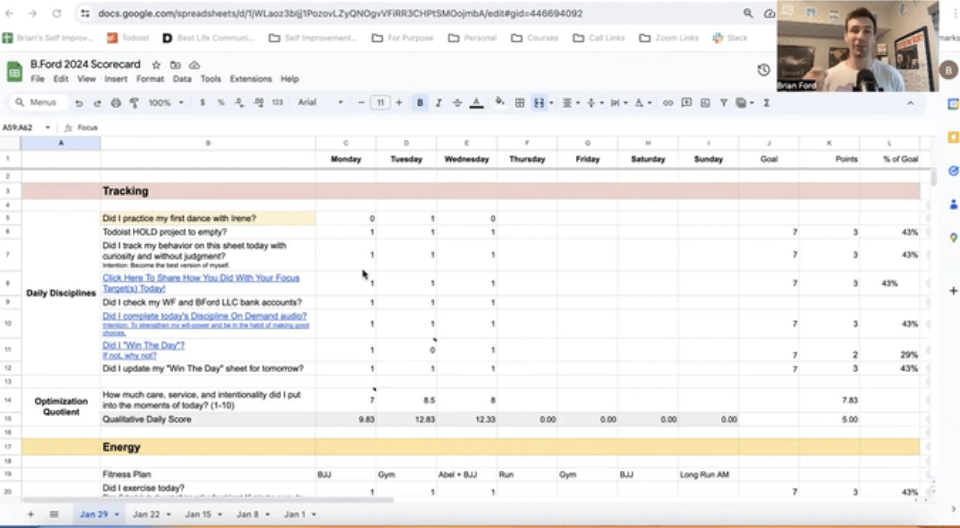
See My Self Improvement Scorecard In Action
Watch The Video