
Data Informed Decision Making
Something I’ve always struggled with is the idea of data-driven decision making. Don’t get me wrong, I’m a huge advocate for capturing data. Every single day in my Self Improvement Scorecard I measure my performance so that I can review the data… But to me something was always missing.
Data is great at quantifying how things went, but it doesn’t always tell you how it came to be. To shape our lives we need to understand the ‘cause and effect’ nature of things. Data tells us the objective effect, which is valuable, but it’s difficult to know among the infinite amount of variables what was most responsible for causing it.
That’s why when Joey Gonzalez, founder and CEO of Barry’s and an empire in fitness, said that he makes data-informed decisions, it really resonated with me.
Data-informed decision making respects that there’s an art and a science to understanding how to navigate forward. The science is the data and the art is the interpretation of factors that influenced the data. The data on its own is dry and robotic, but the interpretation of data is creative and strategic.
Every day I manage this balance between art and science myself. I’ve put a lot of time into clearly defining my standards. For example, my nutrition standard is to honor a 13 hour fasting window, make the ‘healthy’ option available to me, and allow myself one bit of dessert to try it.
On one hand, determining what’s the ‘healthy choice’ sounds like it’s entirely subjective, but over the course of years I actually have a good understanding for what that is.. On a long road trip, stopping at Taco Bell and getting a burrito bowl with no sour cream passes the test as a ‘healthy choice’, but at home with meal prep in my fridge it doesn’t.
Or another example - Last week after date night I chose to have two bites of pumpkin ice cream instead of one. That directly violated my one bite rule and caused me to reflect on why I made that choice.
In both cases, it’s critical to have a reference point to compare against. That’s the science. But then the art comes in when you consider the conditions around the result to arrive at your fully contextualized interpretation.
Am I crazy for putting that level of thoughtfulness into my growth? Maybe. But you might be too, so if you want to see my Self Improvement Scorecard in action and learn how to implement it for yourself, click the link in the description.
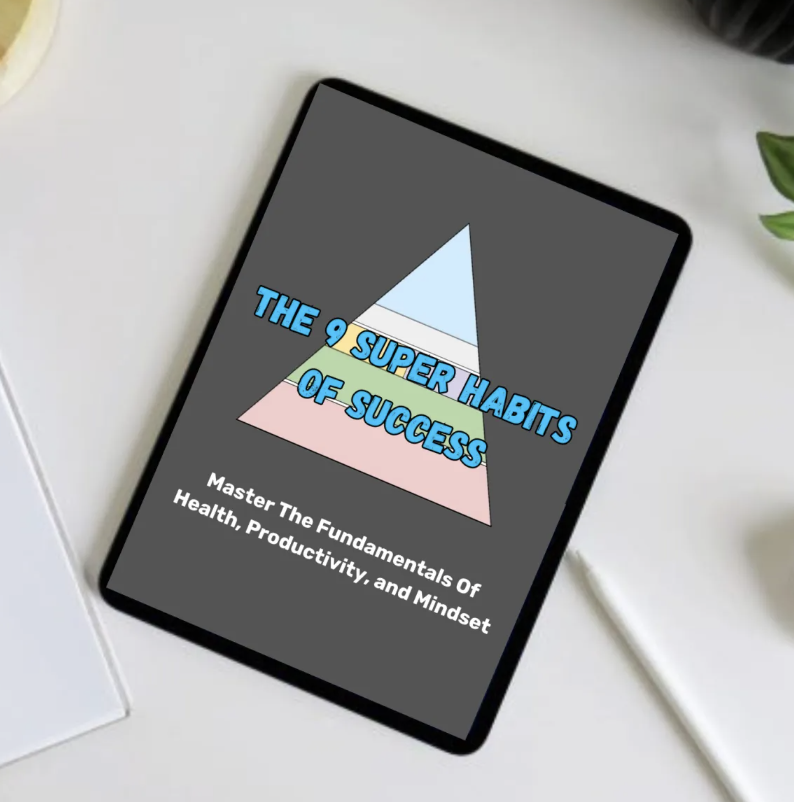
Not All Habits Are Made The Same...
Discover The 9 Super Habits!